
Market Update
Utah's Starter Home Shortage: What Is Actually Holding It Back
Utah’s governor was asked last week whether the state’s push to make housing more affordable has actually worked. He said no. His words were that we have not been as successful as we need to be, and that demand is still outpacing supply.
Officials do not usually answer that question that way, so it is worth taking seriously. It is also worth looking at what is underneath it, because the reasons Utah is behind on housing supply are more specific, and more fixable in some cases and less fixable in others, than the conversation usually allows.
The number: 7,400 against a goal of 35,000
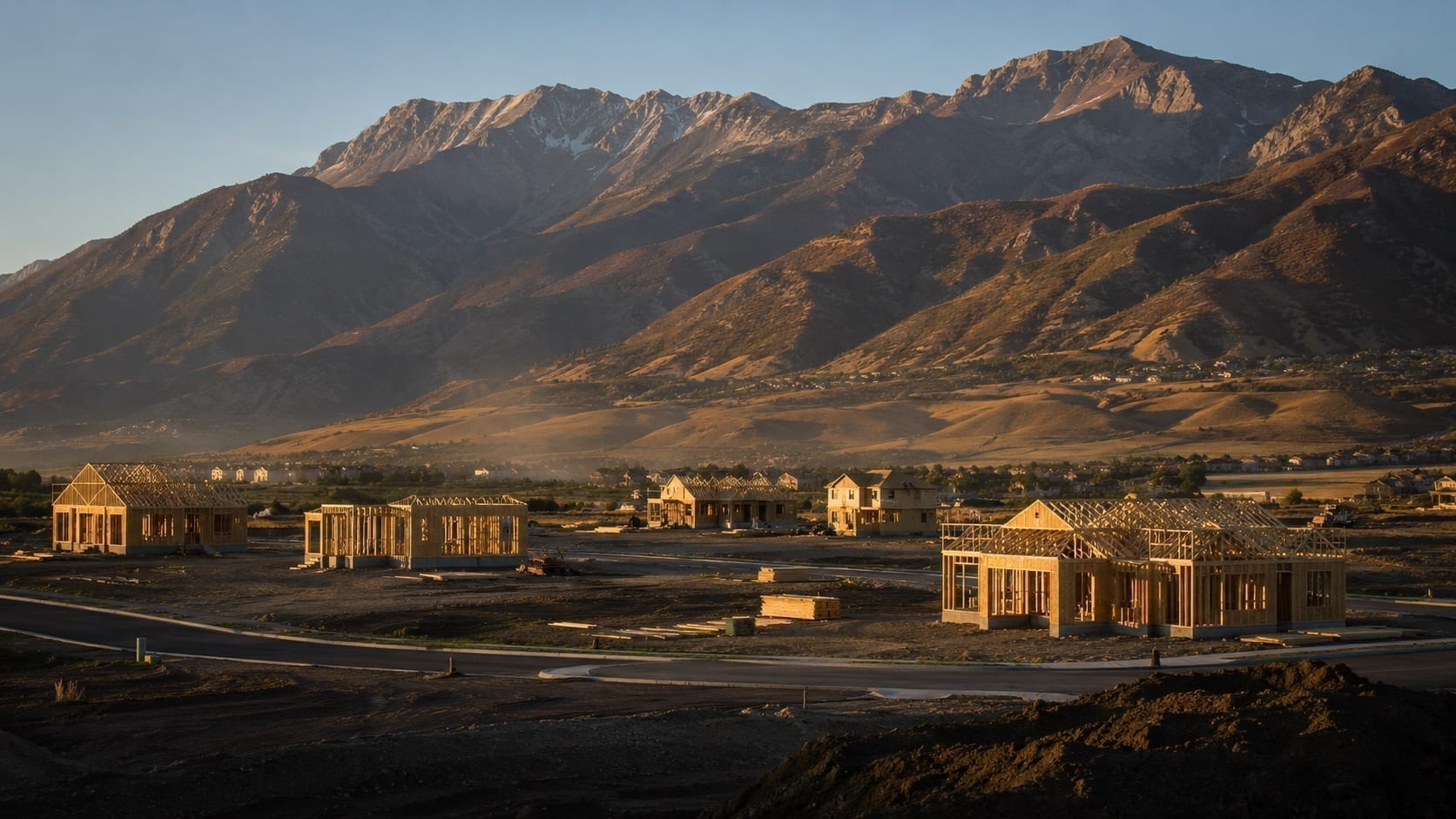
In 2023 the state set a target of 35,000 starter homes by the end of the governor’s second term in 2028. As of KSL’s reporting on August 21, 2026, just over 7,400 have hit the market. That is roughly a fifth of the target with about two years left on the clock.
I later ran that record price against what people here actually earn, ZIP by ZIP, in Utah has priced out its own workforce. There is not one ZIP on the Wasatch Front where a median household can afford the median single-family home.
The shortfall landed in the same stretch that Salt Lake County posted a record median single-family sale price of $645,000 for the second quarter of 2026, according to the Salt Lake Board of Realtors, the highest quarterly median on record and up about 4.9 percent year over year. The board attributed the increase to continued demand for single-family homes despite affordability challenges and high borrowing costs. In other words, the pressure on prices is not coming from speculation. It is coming from people who want somewhere to live and are buying anyway.
To the governor’s credit, he noted that his advisors told him not to publish the 35,000 figure because it would be hard to hit, and he published it anyway. A state that is publicly missing a real number is in better shape than one quietly hitting a fake one.
The first reason: it is not the governor’s decision to make
After more than 20 years selling homes along the Wasatch Front, I do not read this as a failure of effort. Bills passed. Programs launched. The state stood up a new housing division in mid 2026 to coordinate agencies and local governments. The current conversation has moved on to building on surplus state-owned land, which tells you how far down the list of easy options we already are.
The constraint was never ideas and it was never really money. It is that the decision about whether a starter home actually gets built is made by a city council and a planning commission, one parcel at a time. A governor does not sit on any of them. A state housing goal, in practice, gets settled in somebody else’s zoning hearing.
That is not a satisfying answer. If you want that number to move, the meeting that matters is the one in your own city on a Tuesday night with eleven people in the room, and most of the eleven are there to oppose something.
The second reason, and almost nobody is discussing it: water
There is a second limit on Utah housing supply, and it gets very little attention in the affordability conversation even though it is arguably harder than zoning.
Utah just recorded its worst snowpack on record
According to a special report from the Natural Resources Conservation Service Utah Snow Survey, statewide snow water equivalent on April 1, 2026 was 2.7 inches, or 19 percent of normal. Records go back to 1930, and this is the lowest ever measured, by a wide margin. The previous record low was 2015, and 2015 was roughly five times higher than this year.
That is not a bad winter. That is the worst winter in nearly a century of measurement.
You cannot approve a subdivision you cannot water
Here is where that lands on housing. In Utah, a residential development generally cannot be approved without proof that water can actually be delivered to it.
- Counties and cities commonly require written confirmation from the water provider that capacity exists to serve a project. This is usually called a “will serve” letter, and in much of the state it functions as a practical prerequisite to subdivision approval.
- Utah Department of Environmental Quality drinking water feasibility criteria require a letter from the water system stating that a proposed development can be served adequately under existing conditions and for a reasonable time going forward.
- A number of Utah cities require developers to dedicate water rights to the city as a condition of development, rather than simply hooking up to an existing system.
- The Great Salt Lake basin has been closed to most new water right appropriations since a 2022 gubernatorial proclamation. A developer building in that basin is not creating new water. They are buying it from somebody who already holds it, and that cost ends up in the price of the lot.
None of that is a zoning fight and none of it is a political fight. It is arithmetic, and it happens in an office that nobody shows up to. My honest read after more than two decades of this is that in Utah, the will serve letter is the real permit. The zoning approval gets the attention, but the water letter is the one that decides whether homes appear.
What this means if you already own a Utah home
The practical consequence of a supply constraint this durable is that existing homes hold value against a future supply that keeps arriving late. The house that already exists already has its water and already has its approvals. Every year the state misses the target by a wide margin, the scarcity underneath your home’s value gets a little more structural and a little less cyclical.
That is not a reason to sell and it is not a reason to hold. It is a reason to know your actual number rather than an automated estimate, because pricing correctly in the first ten days matters more in this market than it has in several years. If you want to know what your specific home is worth right now, I will pull the closed comparables on your street and walk you through them. You can start with a free home value report, or read how we approach pricing strategy and our 163-step home selling process.
What this means if you are buying new construction
Let me correct something people get wrong about this, including some agents. If there is a model home standing and the phase is actively selling, the water question is already answered for that phase. You do not get a recorded plat without demonstrating service, and you do not get a building permit without it either. So walking into a sales office and asking whether the project has a will serve letter is not sharp due diligence. The answer is yes, and the question mostly tells the sales agent you have not bought new construction before.
The water question is live for the phases that are not built yet, and that is where a lot of new-construction buyers actually are. Reserving a lot that delivers in eighteen months is a different transaction from buying a finished home in Phase 1. A community can be approved at the master plan level and still have later phases that are not final platted, with infrastructure or a water commitment the developer has to satisfy before anything records. So the question is not “does this project have water.” It is “which phase am I in, is it recorded yet, and what is still outstanding on it.”
The honest version of the risk is not that your tap runs dry. It is that your delivery date slides while your rate lock and your lease do not care. Ask what happens to your earnest money, your price, and your incentives if the phase misses its window, and get that answer in the contract rather than in the sales office.
One thing that does hold at any phase: the agent sitting in the model home works for the builder. Bring your own broker to the first visit, not the third, because most builders register you to whoever walked you in the door. That representation is what gets the contract read and gets somebody pushing on lot premium, upgrade pricing, incentives, and the delivery language.
You can browse Utah housing communities here, search active listings at zoomUTAH.com, or read more about our buyer representation.
Frequently Asked Questions
How many starter homes has Utah actually built toward its 35,000 goal?
Just over 7,400 have hit the market as of August 2026, against a goal of 35,000 by the end of 2028. That is roughly a fifth of the target with about two years remaining.
Why are Utah home prices still rising if the state is building more?
Because demand continues to outpace supply. Salt Lake County’s median single-family sale price hit a record $645,000 in the second quarter of 2026, up about 4.9 percent year over year, which the Salt Lake Board of Realtors attributed to continued demand despite affordability challenges and high borrowing costs.
Can a Utah subdivision be denied because of water?
Yes. Utah municipalities and counties generally require proof of water service before approving residential development, whether through a will serve letter from the water provider or a dedication of water rights to the city. In a record-low water year, that requirement becomes a real limit on how much new housing can be approved.
What is a will serve letter?
It is written confirmation from a water provider that it has the capacity to supply a proposed development. In much of Utah it functions as a practical prerequisite to subdivision approval.
How bad was Utah’s 2026 snowpack?
Statewide snow water equivalent on April 1, 2026 was 2.7 inches, or 19 percent of normal, the lowest since records began in 1930. The previous record low, set in 2015, was roughly five times higher.
The bottom line
Utah is not behind on starter homes because nobody tried. It is behind because the two decisions that actually produce housing, a zoning approval and a water commitment, are made locally, slowly, and one parcel at a time, and 2026 handed the state its worst water year on record while it was trying to build its way out of a shortage.
If you are trying to make a decision about your own house inside that picture, whether that is selling, buying, or just understanding what you own, I am happy to give you a straight read. Call 801-999-8005 or start here.
Sources: KSL, “Governor says efforts to reduce Utah’s housing prices aren’t working,” August 21, 2026. Salt Lake Board of Realtors, second quarter 2026 report. Natural Resources Conservation Service Utah Snow Survey, April 2026 special report. Utah Department of Environmental Quality drinking water feasibility criteria. Great Salt Lake basin appropriation closure, gubernatorial proclamation, 2022.