
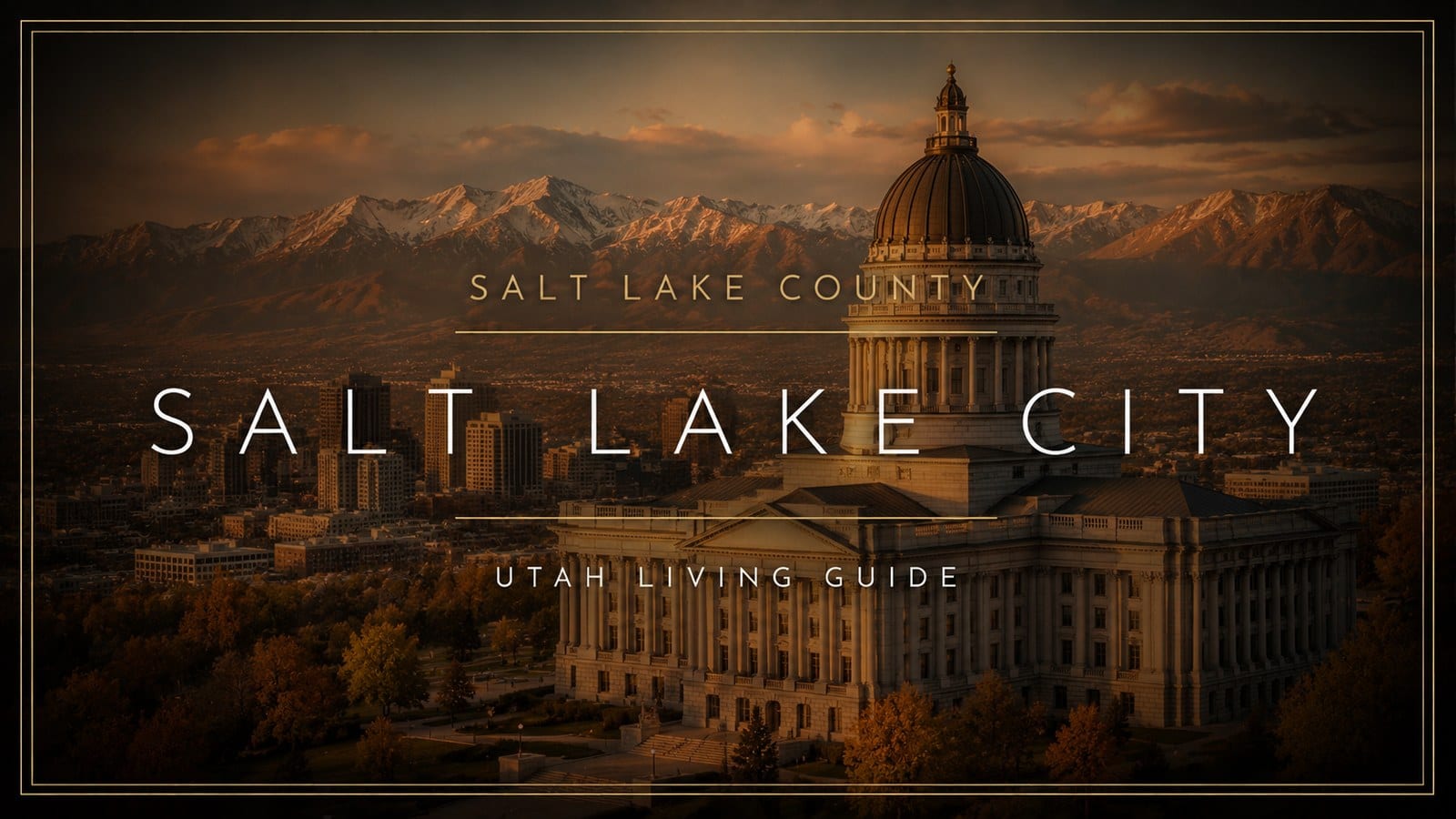
Pros and Cons of Living in Salt Lake City, UT (2026 Guide)
Quick Answer
Salt Lake City offers a $605K median home price, low 3.5% unemployment, world-class outdoor recreation within 30 minutes, and one of the fastest-growing tech scenes outside the coasts. The trade-offs include winter inversion smog, high cost of living relative to the interior West, and a housing market where inventory remains tight even after 34% year-over-year growth.
By Kris Bowen, 23-year Utah real estate broker with 1,000+ closings. Updated July 2026.
Salt Lake City is Utah’s capital and largest city, population around 200,000, anchored by Temple Square, the University of Utah, and a downtown that has grown dramatically over the past 15 years. The 2026 year-to-date median sale price is $585,000 across the city, but neighborhoods range from $300K starter homes to $5M+ Yalecrest homes. Here is the honest read.
The Pros of Living in Salt Lake City
Urban amenities + walkability. Salt Lake City has restaurants, museums, breweries, concert venues, and shopping that the rest of Utah’s suburbs don’t match. The Avenues, Sugar House, 9th and 9th, and Marmalade district are all walkable with neighborhood character.
University of Utah proximity. The U of U brings world-class healthcare (Huntsman Cancer Institute, U Hospital), employment, and cultural amenities. Many east Salt Lake neighborhoods are within 10 minutes of the U.
Historic neighborhoods with character. The Avenues, Capitol Hill, Yalecrest, Sugar House, and Federal Heights have early-1900s homes with character, Craftsman bungalows, Tudor revivals, Victorians. Mature trees, established streets, true neighborhood identity.
Public transit. Salt Lake City has the most TRAX light rail coverage in Utah plus bus service. You can live in central SLC without a car easier than in suburban Utah.
Easy access to both canyons + airport. Salt Lake City is geographically the center of the valley. Big Cottonwood Canyon is 20-30 minutes. SLC International Airport is 15-25 minutes from most neighborhoods. Both are easier from the city than from outlying suburbs.
Cultural diversity. Salt Lake City is the most religiously and ethnically diverse city in Utah. International restaurants, multiple LGBTQ-friendly neighborhoods, and a less-homogenous community vibe than outlying suburbs.
The Cons of Living in Salt Lake City
Inversion (air quality). Salt Lake City catches the worst of Utah’s winter inversion, trapped polluted air, typically December through February. Air quality alerts are common. East-bench and avenues neighborhoods often escape the worst of it but central SLC catches it.
Older housing stock. Many central SLC homes were built before 1950. Plumbing, electrical, HVAC often need updates. Lead paint, asbestos, and knob-and-tube wiring are common in pre-1960 homes. Budget renovation costs.
Property taxes and parking. Salt Lake City has higher property tax than outlying suburbs in some areas. Parking is tight in dense central neighborhoods. Some homes don’t have garages or off-street parking.
Schools more variable. Salt Lake City School District is more variable than Canyons or Alpine. Some schools rate very well (Highland High, Whittier Elementary), others below district average. Verify school assignments by exact address.
Homelessness visible in some areas. Downtown SLC, Rio Grande area, and parts of central SLC have visible homelessness. The city is working on solutions but the issue affects some neighborhoods more than others.
Is Salt Lake City right for you?
Salt Lake City is the best fit if you want urban amenities, walkable neighborhoods, university proximity, public transit, or historic character. It is less ideal if you want newer construction, large lots, top-ranked suburban schools, or to escape winter inversion. Best Salt Lake neighborhoods for buyers: Avenues, Yalecrest, Sugar House, 9th and 9th, Federal Heights, Liberty Wells.
Buying or selling in Salt Lake City?
Kris Bowen has been a licensed Utah real estate broker since 2003. Call 801-999-8005 for a confidential consultation about buying or selling, or get a broker’s read on what your Salt Lake City home is worth.
Frequently Asked Questions
What is the best Salt Lake City neighborhood?
Depends on priorities. Yalecrest for premium historic. The Avenues for hillside character. Sugar House for walkable urban-suburban. Liberty Wells for emerging value. 9th and 9th for hip lifestyle. Federal Heights for east-bench premium. Each has distinct character.
How does Salt Lake City compare to suburban cities?
SLC offers urban amenities, walkability, transit, diversity, university access. Suburbs offer newer construction, larger lots, better-rated schools, lower density. Different lifestyles entirely.
What is the median home price in Salt Lake City?
2026 year to date: median sale price $585,000, average $730,428, across 1,745 closed sales with an average Days on Market of 51. That is the highest volume in Salt Lake County by a wide margin.
Is Salt Lake City safe?
Most neighborhoods are safe. Crime is concentrated in specific areas (downtown homeless services area, Rio Grande). Suburban-style east-bench neighborhoods have low violent crime comparable to top suburbs.
Is Salt Lake City a good place to retire?
Yes for retirees who want urban amenities, walkability, healthcare access, and cultural diversity. The Avenues and Sugar House are particularly popular with retirees who want to leave the suburbs and downsize to walkable urban living.
Browse Active Listings
Looking at homes in Salt Lake City?
See every active Salt Lake City listing on the MLS in real time, updated every 15 minutes from the source feed.
Search All Homes for Sale in Salt Lake City →
Already own in Salt Lake City?
The other half of this decision is what your current home is worth. Send the address and you get a broker’s read priced off what has actually closed near you, not an automated estimate.